

Finding a rental home in the Greater Toronto Area (GTA) can often feel like a high-stakes, fast-moving marathon. Between fluctuating inventory, competitive bidding on desirable units, and strict landlord screening requirements, searching for a place to live can quickly become overwhelming—especially if you're navigating the market for the first time or relocating from outside Ontario.
Whether you're looking for a downtown Toronto high-rise condo, a townhouse in Mississauga, or a family home in York or Halton Region, success comes down to preparation, timing, and knowing how the Ontario rental system actually works.
In this ultimate guide, we walk you through the entire rental journey from start to finish—breaking down costs, application requirements, tenant rights, and red flags—while pointing you to in-depth resources for every phase of your search.
Contents
1. Understanding the GTA Rental Market
The GTA is one of Canada’s largest and most dynamic rental markets. However, inventory and lifestyle differ dramatically depending on where you look:
City of Toronto (Downtown, Midtown, West End, East End): Characterized heavily by high-density high-rise condos and converted multi-unit houses. Proximity to subway lines (TTC) and walkability command premium rents, and competition for turnkey 1-bedroom and 2-bedroom units moves quickly.
Peel Region (Mississauga, Brampton, Caledon): A mix of suburban subdivisions, multi-bedroom townhomes, basement suites, and a growing condo core around Square One. Popular for commuting professionals and families seeking more square footage.
York Region (Vaughan, Markham, Richmond Hill): Highly sought-after for newer condo master-planned communities (such as the VMC transit hub in Vaughan and Downtown Markham) and spacious detached homes near top-rated schools.
Halton Region (Oakville, Burlington, Milton): Known for quiet, upscale suburban living with GO Transit connectivity into downtown Union Station, offering high-end townhomes and lakeside apartments.
The Home Search Triangle
Every renter operates within what we call the Rental Search Triangle: Price, Location, and Space. You can almost always secure two, but rarely all three without compromise.
If you are feeling stuck between choosing a smaller downtown condo or a larger suburban home with a longer commute, check out our guide on The Rental Search Triangle to help narrow down what matters most to you.

2. Budgeting Beyond Rent: Real Costs
One of the biggest mistakes renters make is budgeting only for the monthly rent figure listed on the advertisement. In Ontario, setting up a new tenancy involves upfront and recurring expenses that must be accounted for.
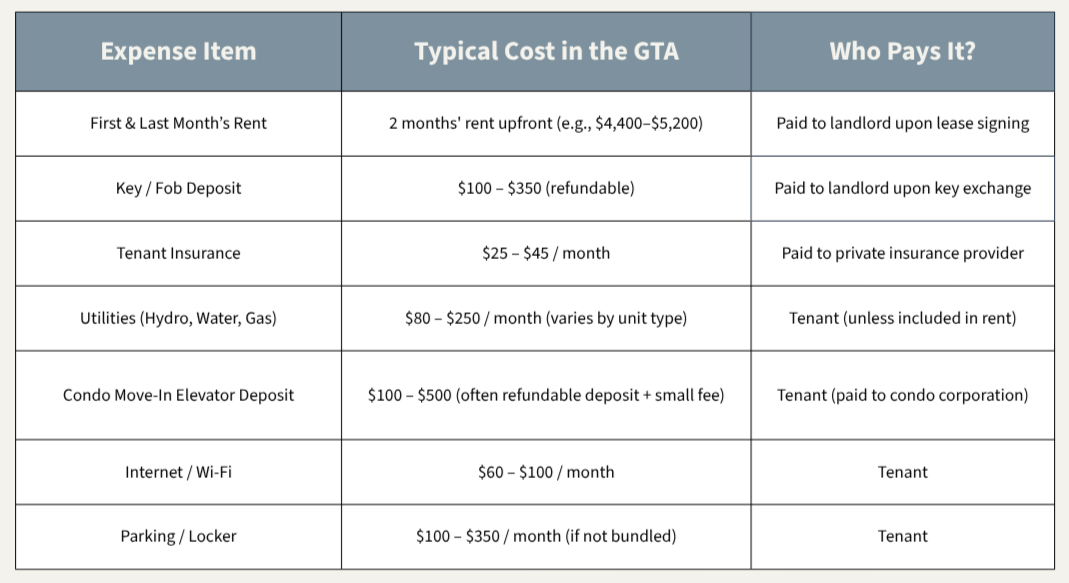
The true cost of renting in the GTA: typical upfront deposits, monthly utilities, insurance, and condo fees to budget for beyond base monthly rent.
Income-to-Rent Guidelines
Most Ontario landlords and property managers look for a gross monthly household income that is at least 3 times the monthly rent (roughly a 30%–35% rent-to-income ratio). For example:
For a $2,200/month rental, landlords typically expect a combined household income of at least $75,000 to $80,000/year.
For a $2,800/month 2-bedroom rental, landlords look for around $100,000/year.
Looking for practical ways to keep your expenses in check? Explore our articles on 9 Savvy Ways to Cut Costs When Renting in the GTA and How Young Professionals Can Live in Luxury Condos Without Breaking the Bank.
3. The Ideal Search Timeline
Timing is critical in Ontario because of the legal notice periods mandated by the Residential Tenancies Act (RTA). In Ontario, existing tenants must give their landlord 60 days' written notice to terminate a lease at the end of their term.
Here is the ideal timeline for your search:
60 to 75 Days Before Move-In: Begin auditing your finances and pull your full credit reports. Research target neighbourhoods, school districts, and transit routes. Do not book private showings yet—landlords listing properties today are looking for tenants to take possession within 30 to 45 days.
30 to 45 Days Before Move-In (The Sweet Spot): This is when the vast majority of MLS rental inventory goes live. If you want to move on July 1st, your active showing window is between May 15th and June 10th.
15 to 30 Days Before Move-In: This is your decision and offer window. Most offers to lease in Ontario are submitted, negotiated, and finalized within 48 to 72 hours of viewing a property.
To avoid costly missteps, read our breakdown on The Biggest Roadblock for Renters in the GTA and How to Avoid It.
4. Assembling a Winning Application Package
In a competitive market, landlords rarely wait for an applicant who says, "I'll send my credit score tomorrow." When an attractive listing hits the market, the listing agent will review offers on a first-come, best-qualified basis.
Have these five core items organized into a clean, PDF package before stepping foot into a showing:
1. Full Equifax or TransUnion Credit Report
Landlords want to see your full multi-page report, showing your credit score (ideally 670+), trade lines, payment history, and any outstanding collections. A single-page summary screenshot from a banking app is often rejected by listing agents.
Learn how credit scores are evaluated and how to strengthen your profile in How Your Credit Score Impacts Renting in the GTA—And How to Improve It.
2. Comprehensive Letter of Employment
Must be on official corporate letterhead, dated within the last 30 days, signed by HR or a manager, and include:
Your job title
Employment status (must specify permanent full-time)
Annual salary or hourly rate + guaranteed hours
Length of tenure with the company
3. Recent Pay Stubs
Provide your two to three most recent consecutive pay stubs to verify the numbers stated in your employment letter.
4. Government-Issued Photo ID
A clear copy of your driver's licence, passport, or Permanent Resident (PR) card for identity verification.
5. Landlord References & Rental History
Contact information (name, phone number, email) for your current and previous landlords. If you owned your previous home, providing property tax or utility statements can verify past homeownership.
Unsure if your profile meets standard landlord requirements? Take our Free Rental Qualification Quiz

Having your credit report, employment letter, and references organized in advance gives you an edge on competitive GTA rentals.
5. Where to Search: MLS vs. Classifieds
Where you source your listings has a direct impact on your security, your representation, and the types of landlords you deal with.
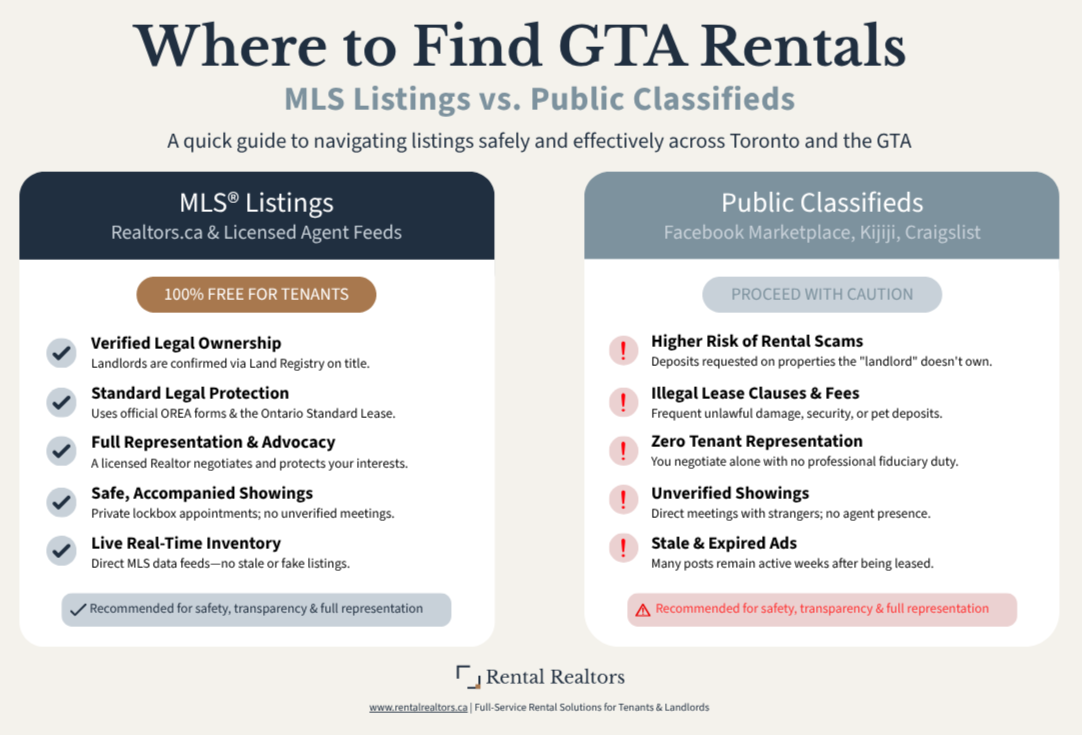
Comparing MLS listings versus public classified sites: why MLS offers verified ownership, standardized legal leases, and zero cost for tenants across Toronto and the GTA.
The Multiple Listing Service (MLS)
Listings posted on the MLS via Realtor.ca or directly through a licensed Realtor represent professionally managed transactions. Property ownership is verified through Land Registry records, listing brokerages ensure legitimate keys/access, and transactions use standardized legal paperwork.
Public Classified Sites (Kijiji, Facebook Marketplace, Craigslist)
While classified sites offer private basement apartments and room rentals, they carry significant exposure to rental scams (e.g., fraudulent "landlords" collecting deposits on units they do not own, phantom listings, and illegal lease clauses).
For a vetted list of online resources, check out our guide on 8 Game-Changing Sites You Need to Know to Find Your Dream Rental.
6. Why Use a Realtor to Rent?
One of the most persistent myths in Ontario is that working with a Realtor to find a rental costs the tenant money.
In Ontario, tenant representation is 100% free for renters.
How Commission Works
When a landlord lists their property on the MLS, they agree to pay a total leasing commission (typically one month's rent). That commission is split between the landlord’s listing brokerage and the tenant’s cooperating brokerage.
What a Rental Realtor Does for You:
Curates Unfiltered MLS Inventory: Access real-time MLS data as soon as listings hit the market, rather than seeing stale or already-leased properties.
Schedules & Escorts Private Showings: No awkward messaging back-and-forth; your agent books private appointments and walks through units with you.
Conducts Landlord Due Diligence: Verifies that the individual leasing the home is the registered legal owner on title.
Drafts Protective Offers: Uses official Ontario Real Estate Association (OREA) forms with custom protective clauses (professional cleaning, appliance warranties, key deposit terms).
Negotiates on Your Behalf: Advocates for your application when competing against other potential tenants.
Read more about how professional representation protects you in Why Using a Real Estate Agent Can Make Your Rental Search Easier.
7. In-Person Showings & Hidden Red Flags
When you step into a potential rental home, don’t just look at the paint colour or staging furniture. Look at the operational elements of the home:

During showings, check water pressure, climate controls, and window seals rather than just decorative finishes.
Plumbing & Water Pressure: Turn on showerheads and sink faucets simultaneously. Check beneath sinks for signs of previous leaks, water stains, or mould.
Heating & Cooling Infrastructure: Ask how the unit is heated and cooled. Is it central air conditioning or a window unit? Does the thermostat control your unit exclusively, or is it shared with another tenant?
Windows & Soundproofing: Open and close windows to inspect seals and gauge outdoor traffic noise.
Cell Phone Reception: Walk through all rooms (especially in high-rise concrete buildings or basement suites) to verify that your mobile carrier maintains strong signal.
Condo Building Rules & Amenities: Inspect the laundry facilities, garbage chutes, visitor parking rules, and pet restrictions.
For a comprehensive walkthrough guide, read Don't Sign That Lease Yet! 6 Hidden Red Flags to Spot During Your Rental Tour.
8. Ontario Lease Rules, Deposits & Rights
Tenant rights in Ontario are governed by the Residential Tenancies Act (RTA) and enforced by the Landlord and Tenant Board (LTB). Understanding these core rules protects you from predatory requests:
The Ontario Standard Lease is Mandatory
Private residential tenancies established after April 30, 2018 must use the official Ontario Standard Form of Lease. If a landlord has you sign a handwritten agreement or an arbitrary document, you have the legal right to demand the official Standard Lease within 21 days.
What Deposits Are Legal in Ontario?
Under Section 105 of the RTA:
Rent Deposit (Legal): A landlord can collect a rent deposit equal to one month’s rent (typically applied to your last month of tenancy).
Key Deposit (Legal): A landlord can collect a refundable key/fob deposit, provided it does not exceed the actual replacement cost of the keys.
Security / Damage Deposits (ILLEGAL): A landlord cannot legally collect a "damage deposit," "cleaning deposit," or "pet deposit." Any clause requiring one is void and unenforceable.
The November 15, 2018 Rent Control Cutoff
Rent control rules in Ontario depend on when the property was first occupied for residential purposes:
Units Occupied BEFORE November 15, 2018: Subject to Ontario’s annual rent increase guideline (typically 2% to 2.5% per year), capped by the provincial government.
Units Occupied AFTER November 15, 2018: Exempt from provincial rent control. Landlords can raise the rent by any amount they choose once every 12 months, provided they give 90 days' written notice on an N2 form.
9. Closing the Deal and Move-In Prep
Once the landlord accepts your Agreement to Lease, you enter the formal closing phase:
Submit the Rent Deposit: Your deposit (first and last month's rent) must be delivered via bank draft or certified wire transfer to the listing brokerage's real estate trust account within 24 hours of formal acceptance.
Execute the Ontario Standard Lease: Both parties sign the official standard lease document.
Secure Tenant Insurance: Purchase your tenant insurance policy ($1M to $2M personal liability coverage) and forward the Certificate of Insurance to the listing agent.
Transfer Utilities: Contact Toronto Hydro (or local municipal utility providers), Enbridge Gas, or sub-metering companies (like Provident or Priority Submetering) to establish service starting on your possession date.
Book the Elevator: If moving into a condominium, contact property management immediately to reserve the service elevator for your moving truck. Most buildings require a refundable damage deposit during your moving window.
For a full relocation roadmap, check out 8 Steps to Make Renting in the GTA an Adventure (Not a Headache).

Once your lease is signed and deposit delivered, secure your tenant insurance and book the elevator early for moving day.
10. Frequently Asked Questions (FAQ)
Do I have to pay a Realtor to help me find a rental in Toronto?
No. In Ontario, Realtors representing tenants are compensated by the landlord’s listing brokerage out of the total leasing commission. You receive full representation, advice, and contract drafting at zero out-of-pocket cost.
Can a landlord refuse to rent to me if I have a pet?
Under Section 14 of the Ontario RTA, "no-pet" clauses in tenancy agreements are void as a matter of law. A landlord cannot evict you simply for having a pet. However, condominium declarations supersede the RTA—if a condo building's registered declaration prohibits dogs over 25 lbs or limits the number of pets, that rule is legally binding.
What if I don't have Canadian credit history (Newcomer / PR)?
If you are moving to Ontario for work without a local credit score, landlords typically request your signed Canadian employment contract, proof of liquid savings, and sometimes voluntary upfront rent deposits (e.g., 3 to 6 months prepaid) to offset credit risk.
Can a landlord ask for 6 or 12 months of rent upfront?
A landlord cannot require more than first and last month’s rent as a condition of leasing. However, the Ontario courts have established that a tenant can voluntarily offer additional rent upfront to strengthen their application if their credit or employment history is non-traditional.
11.Ready to Find Your Ideal Rental in the GTA?
You don’t have to navigate competitive listings, unresponsive landlords, and complicated paperwork on your own.
At Rental Realtors, our licensed real estate agents help you find, vet, and secure the right rental home across Toronto, Peel, York, and Halton—at no cost to you.
👉 Start Your Search with Our Rental Discovery Form
Tell us your budget, preferred neighbourhoods, and move-in timeline, and let our team match you with verified, available rental listings today.
Explore More Rental Guides & Resources
Looking to dive deeper into specific parts of your rental search? Here are some of our most popular guides in the Finding Rental Properties category:
11 Reasons Why Renters Should Use a Real Estate Agent: Discover why working with a licensed Realtor gives you an advantage in the GTA rental market—and why it’s 100% free for tenants.
Nailing Your Rental Application: 7 Tips for Success: Insider strategies to make your application stand out to GTA landlords when competing against other applicants.
Essential Documents Needed to Rent in Ontario: The definitive checklist of IDs, letters, pay stubs, and financial statements you need ready before booking viewings.
Understanding Ontario’s Standard Lease: 17 Key Sections: A clause-by-clause breakdown of the mandatory Ontario Standard Lease and what each section means for you.
What You Need to Know About Rent Control in Ontario: How the November 15, 2018 guideline rule affects your yearly rent and what to watch out for before signing.
What Are Your Rights as a Tenant in Ontario?: Understand eviction protections, maintenance responsibilities, and how the Landlord and Tenant Board (LTB) operates.
